
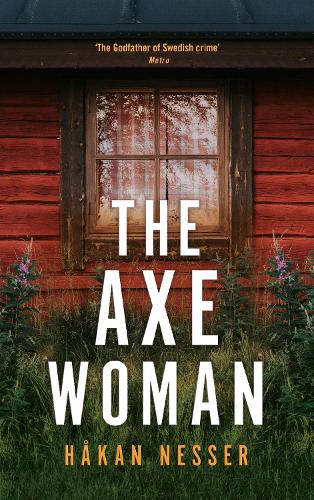
THE AXE WOMAN
Håkan Nesser (nesser.se)
Translated by Sarah Death
Mantle (panmacmillan.com)
£18.99
Inspector Gunnar Barbarotti returns to work following the sudden death of his wife as they slept in bed together. In order to ease him back into things, his boss hands him a cold case file and asks him to investigate: a man who went missing several years earlier, the only trace of him the blue moped on which he went to the shop. The man was never found, and questions remain about why his partner at the time waited three days to call the police. The partner who has something of a history of her own, “The Axe Woman of Little Burma” – this is not the first time Ellen Bjarnebo has misplaced her husband.
Then he was jolted awake by something like an electric shock, running from his hand via his arm and his whole body. It exploded in his head like a flash of ice-cold lightning.
The chill. The absence.
The utter lack of sound and movement. Every atom of every cell in him knew what had happened, before the viscous membrane of his consciousness was ripped apart by a silent scream and a No.
Time for an admission: despite the fact that I enjoy a good Scandicrime novel as much as the next reader, I’ve never before read the so-called “godfather” of the genre, Håkan Nesser, so I’ve gone into his latest novel, The Axe Woman, completely cold, with no idea what to expect, or who these characters are. Needless to say, from the very first chapter – from which the quote at the head of this review comes – I was hooked, and keen to see what sets Gunnar Barbarotti apart from his contemporaries. The suddenness of his wife’s death is as compelling as anything I’ve read recently, and beautifully conveyed to the reader.
Gunnar Barbarotti is an interesting and complex character. The Axe Woman may not be the best introduction, given that it introduces us to a man living through exceptional circumstances. Depending on what you’re looking for, this is presumably not the best side of Gunnar Barbarotti. On the other hand, this is a man at his lowest ebb, and Nesser gives us heartbreaking insight into what the detective is going through. Barbarotti has a dark sense of humour which peeks through here and there (despite the circumstances), but the sense we really get is of a man of faith looking for a reason to continue, and finding it in his work, his friends – in the form of colleague Eva Backman – and his family.
Time and history seem to be arrayed against Barbarotti as he tries to get to the bottom of not one but two cold cases. It quickly becomes evident to the inspector that his boss has an ulterior motive for asking him to look at this file, which makes his investigation less of a piece of “make-work” and more of a challenge to be surmounted, a true test of his investigative powers. Barbarotti goes to every extreme, and to the wilds of Northern Sweden, to get to the bottom of the two mysteries that surround the Axe Woman of Little Burma. In the process, he finds his way back to the world, and comes to terms – as much as humanly possible – with the hole in his life left by the loss of his wife.
The Axe Woman is at once touching and gripping. For new readers like me, it presents a man who is very different to all other fictional cops: a man of faith, struggling to regain his place in the world following unspeakable personal tragedy. For long-time fans of Håkan Nesser and the Barbarotti books, it presumably presents a new facet of a character that they have grown to love over the years. Mixed in with this very human story – a story that, as the kids say, gets you in the feels – is an intriguing case that, in many ways, parallels Barbarotti’s return to normality. It’s a story that keeps the reader guessing until the very end and for this reader, it’s a reminder that I really need to read more Nesser. While it may not be the best starting point from the point of view of character development, it’s a story that highlights a writer at the height of his powers, a writer who’s not afraid to take risks, and who isn’t afraid to pour his heart out onto the page. The Axe Woman may well be the most affecting novel you’ll read this year. It definitely won’t be my last visit with Inspector Barbarotti.

 Reader Dad - Book Reviews
Matt, I like you, have not read any Håkan Nesser.
Great review, but it doesn’t sound like the best place to start.
I wonder if you (or your readers) would recommend something else?
This may be an impossible question given that you say this is your first, but as my mother always told me, “if you don’t ask, you won’t get”
Hi James, thank you!
As you guessed, I’m probably not the best person to advise on the best place to start, though I find the first book in a series is always a good place (in this case that’s THE DARKEST DAY), but hopefully someone else will be able to chip in and provide some recommendations.
Thank you