
THE CURATOR
Owen King (owen-king.com)
Hodder & Stoughton (hodder.co.uk)
£20.00
Buy a copy from your favourite independent bookshop
In an unnamed city in a world not unlike our own, revolution has ousted the people who have been in charge for generations. Dora, a young maid at the university, walks out of her job with one of the student radicals and decides this is the time to find out what happened to her brother, Ambrose, fifteen years earlier. In the upheaval, she decides to take over the Society for Psykical Research — where her brother claimed to be saving worlds before succumbing to cholera and being “disappeared” — but instead finds herself the curator of the building next door to the Society’s charred remains: The National Museum of the Worker, with its strange tableaux of wax figures which seem to be evolving over time. As the city stagnates, waiting for the revolutionaries to make the next move, Dora discovers that her brother was right: there are other worlds, and the revolution isn’t what it seems. Someone is using it as a cover for something much more nefarious, and Dora may be the only person standing in their way.
The city — nicknamed “the Fairest” by poets and municipal advocates for its river, the mighty Fair — jutted from the body of the country like a hangnail from its thumb.
So we are introduced to this colourful city in which we will meet young Dora — or “D” as her brother nicknamed her — and the cast of unlikely supporting characters that populate Owen King’s latest novel. The Curator is categorised as fantasy, but contains enough elements of horror, crime and historical fiction to blur any lines you might wish to draw around this extraordinary novel. It’s right that we should be introduced to the city first, though we are never given its name, as it is the backbone that holds all of the characters and their interwoven stories together. King has spent considerable time putting the landscape together, from the rich north end of the city to the poor slums — the Lees — at the southern end. This is a city of cat-lovers, and not a few cat-worshippers, and the creatures also play a central role in the story, and can be found in the city’s three grand hotels, the cafes and the many museums. And while the inhabitants of the Lees struggle to survive, the city’s rich indulge in their favourite pastime: visiting the Morgue Ship to see whichever corpse is currently on display in its tub of ice.
Much of the story centres on Dora, who may be the titular Curator. She’s young and vibrant, quick-witted and sharp-tongued, very much in love with her volunteer lieutenant, and driven by a desire to find out what happened to her brother, Ambrose. She finds a purpose in her new role, restoring the museum’s wax figures to their former glory, replacing old clothes and missing glass eyes. But she also discovers that her next-door neighbour, the mysterious Captain Anthony is torturing and murdering people in the former embassy and dumping the increasingly foul-smelling remains in the stables to the building’s rear. D enlists the help of a young rascal named Ike, who runs errands and slowly, but surely, loses his heart to the young woman. These are but a few of the eclectic cast you’ll meet when you step foot into King’s nameless city, from barmaids to dockworkers, students to tram drivers, playwrights, potters and soldiers. The Curator is like an intricate clockwork mechanism, full of finely-wrought moving parts which mesh beautifully with each other — whether it’s people, animals or places — to create an involved and thoroughly enjoyable tale.
Once he had told her that there were other worlds.
Of course, Stephen King fanboys like me are going to analyse every word of this, and the concept of “other worlds” is one we’ve heard before. Presented almost as a throwaway line in the novel’s opening chapters, this concept will prove to be central to the storyline. Dora’s world is not too different from our own. Despite the fantastical feel of the novel’s setting, this a world where Roman legions once ruled most of the known world; it’s a world where London, Paris and Switzerland all exist. And as the story progresses, King adds little touches here and there to show the worlds leaking into each other, not to mention doorways that will transport people between them.
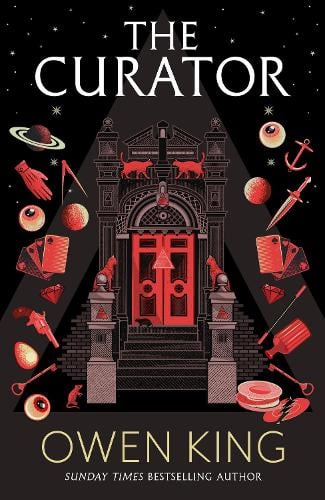
The book’s gorgeous cover proclaims King “the Sunday Times bestselling author of Sleeping Beauties.” The Curator is sure to be his breakout solo novel. The talent here is all Owen, and what a prodigious talent is on display. It’s a cleverly-constructed piece, like a clockwork toy with secret compartments ready to reveal what’s hidden within. It’s beautifully-written, in an almost playful voice that stands in stark contrast to some of the horrors we will find between these covers, and contains a handful of gorgeous silhouette-like illustrations by Kathleen Jennings. And every single reader, like our good friend Ike, will lose a piece of their heart to Dora and will reach the end of this wonderful story completely satisfied, but also a little sad that we must leave her behind. Hopefully it will send readers in their droves to King’s earlier works (short story collection We’re All in This Together, novel Double Feature, and the excellent comic Intro to Alien Invasion with Mark Jude Poirier and Nancy Ahn) and, more importantly, lay the groundwork for many more excellent novels to come.

 Reader Dad - Book Reviews