
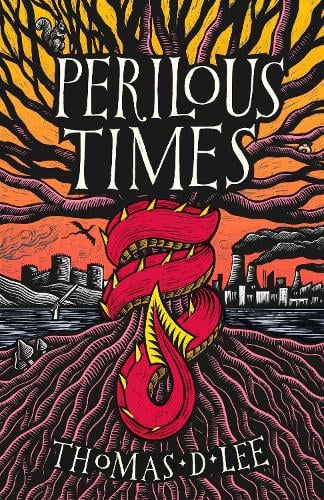
PERILOUS TIMES
Thomas D Lee (thomasdleewriter.wordpress.com)
Orbit (orbit-books.co.uk)
£16.99
Buy a copy from your favourite independent bookshop
Fabled Knight of the Round Table Sir Kay has been dead for sixteen hundred years. Well, mostly. Thanks to Merlin’s magic Kay and his fellow knights have been buried around the realm in sites guarded by sacred trees. When the realm is in peril, they are resurrected so that they can save the kingdom from whatever threat it faces. As a result, Kay has fought in every one of Britain’s wars for over a millennium and a half. Now Kay finds himself awakened just as Mariam blows up a fracking site within sight of his tree. The realm is once more in peril, this time from the climate, and Kay decides that joining forces with Mariam and her activist sisters – who go by the unlikely moniker of FETA – is the best way to help out, especially when Mariam’s act of sabotage unleashes a dragon upon the world. Ranged against them are an unlikely foe: the forces of Saxon Security, 16th Century playwright Christopher Marlowe and Sir Lancelot, who have an unthinkable plan to bring King Arthur back from the land of faerie, where he has been locked away since his death.
Thomas D Lee’s debut novel has – rightly or wrongly – garnered comparisons to the work of Terry Pratchett and Neil Gaiman, but that doesn’t do his tale of Arthurian knights in a very-near-future Britain any favours, and goes some way towards pigeonholing it incorrectly. Yes, it’s funny and there are definitely parallels with the likes of Good Omens, but that barely scratches the surface of what is, ultimately, a complex novel, a love/hate letter to Britain, a warts-and-all examination of a once-great nation’s embarrassing latter days, seen through the eyes of a man who has been through more or less every milestone of that nation’s history. If anything, Perilous Times probably has more in common with Gibbon’s History of the Decline and Fall of the Roman Empire than with anything else.
As the novel opens, we meet Kay as he is pushing his way out of the mud, ready to fight whatever new peril is threatening Britain. He can tell immediately that something isn’t right – it’s too hot, and the air smells wrong. At a nearby fracking site he encounters Mariam seconds before the bomb she has planted explodes, and the security force engaged to guard the site – named after Arthur’s mortal enemies – start shooting at them. Mariam is young and somewhat idealistic, a member of the Feminist Environmentalist Transgressive Alliance, whose aim is to fight the climate emergency with every resource at their disposal. Quickly assuming that this climate emergency is the peril for which he has been resurrected, Kay joins forces with the women, hoping that by travelling to Manchester with them, he might be able to get his hands on Excalibur, and slay the rogue dragon in the process.
Set in a very plausible near future, this is a world on the brink of a climate catastrophe. Much of Britain has been flooded – whole religious groups have sprung up around the Second Great Flood – and hundreds of thousands of people displaced and living in squalor in refugee camps up and down the country. Groups have sprung up across the country, all fighting for different causes, from the communists, to the Welshmen who follow the new self-proclaimed King of Wales, and the Army of Saint George who – as you might be able to guess – want to preserve the British way of life. But the real power in the realm lies, as always with the ultra-rich who, coincidentally, are the main reason the world is in its current sorry state. The focus for both sides is the giant oil rig that has been built on what was once the Somerset Downs. Avalon, as it has been named, is the new headquarters for the government, and a symbol for Mariam of everything that is currently wrong with the country.
Lee’s novel is thoroughly researched, and we get a real sense of the age of these central characters: Sir Kay; a very different Sir Lancelot to the one we might have expected; and Marlowe who, unlike the knights, has been alive permanently since the sixteenth century. Other, more or less famous, figures from the Arthurian mythology turn up in larger or smaller cameos as the story progresses: Arthur himself, a very different king to the chivalrous knight that lives in the country’s collective consciousness; Nimue, the Lady of the Lake; Morgan le Fay; and the Hawaiian-shirted Merlin, living in a large cave in the middle of nowhere surrounded by equal amounts of magical and technological crap, including one very old cup:
Merlin opens an old suitcase and pulls out a cloth sack. When he strips the sack away, he’s holding something that Kay recognises from the old days. A cup of tarnished bronze. Ordinary and extraordinary at the same time. Lots of men went searching for that cup, for a number of misguided reasons. Most of them didn’t come back. Good to know that Merlin’s been keeping it in an old suitcase on the floor of his cave.
At its core, and amongst all the comedy, Perilous Times examines a number of serious issues. The first, and most obvious, is the climate emergency that we, as a race, seem to be facing if we don’t change our ways. Lee’s world is one where the oil barons hold sway, and so the planet has tipped over the edge. The central characters may hail from the past, but the setting is a very plausible future that may not materialise in my lifetime, but almost certainly within my son’s. Slightly (though not by much) more subtle than his climate message is Lee’s skewering of post-Brexit Britain. The world that Kay finds himself awakened in is one of partition and division. This is no longer a United Kingdom, with a King of Wales, a Republic of Scotland, and an England with a distinct “little England” attitude, as displayed when one man tells Kay to go back to his own country because of his dark skin. Unfortunately, the very people that need to hear Lee’s message are the same people who won’t read the book because of its “woke” messaging.
Thomas D Lee’s Perilous Times is nothing short of a masterpiece. It’s the type of book to get lost in of an evening, at times hysterically funny and at others deeply touching (the scene where Kay wonders why he has been fighting the same war over and over again for over a thousand years is particularly affecting). It is impeccably researched, both in terms of the history and in terms of where Britain has been and where it appears to be going, but never to the point where the detail gets in the way of the story. It’s a novel with some important messaging, but it’s also a fun medieval-in-the-future romp, a sort of reverse A Connecticut Yankee in King Arthur’s Court for the modern reader. I see big thing in Lee’s future, and can’t wait to see what he comes up with next. Put Perilous Times on your list. You won’t be sorry.

 Reader Dad - Book Reviews