
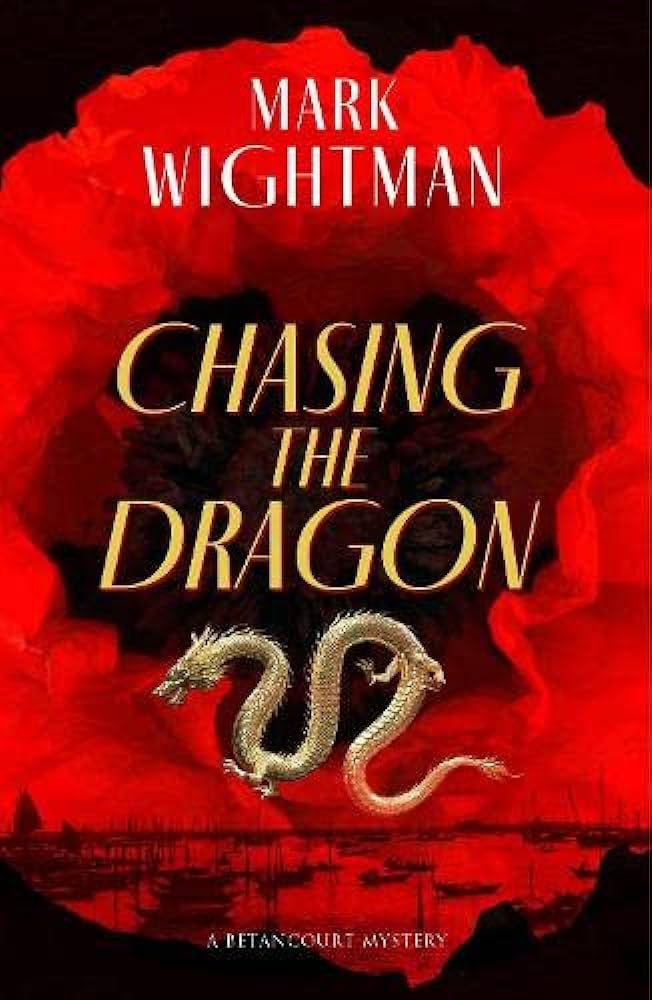
CHASING THE DRAGON
Mark Wightman (markwightmanauthor.com)
Hobeck Books (hobeck.net)
£9.99
Buy a copy from your favourite independent bookshop
Singapore, 1940. The body of an American archaeologist gets caught in a fishing platform off the island’s southern shore. He has been wrapped in a fishing net and has been force-fed two balls of rough opium. Inspector Max Betancourt of the Marine Police is first on the scene, and is immediately convinced that this was no accidental death, despite what his superiors, and the American Consulate, have urged him to find. As he investigates Richard Fulbright’s death, he discovers that nothing adds up: this was a brilliant man, in line for a once-in-a-decade prize for his work in translating the Singapore Stone, but he had become enmeshed in a conspiracy that involved the government-run opium packing facility just outside town, the British Army and a glamorous British expatriate with poor judgement in horses. Betancourt must get to the bottom of the mystery while navigating the complexities of his own personal life, as well as several attempts to put him out of action by people connected to the Fulbright case.
Chasing the Dragon is the second book in Mark Wightman’s Betancourt series, and it’s a reasonably good time to jump on (the first book, Waking the Tiger, would be better if you have time, obviously!). There’s some history that the author tries to recap which will give new readers (like me!) a good handle on what’s going on, as well as how the land lies between Betancourt and the other characters we’ll encounter along the way: former love interest and new Police Surgeon Evelyn Trevose; Marjorie French, the gatekeeper for Betancourt’s boss, Assistant Commissioner Bonham; and young, enthusiastic Sergeant Quek. The mystery here, as you might expect, is self-contained, so there is no bleed-through from the previous case.
Betancourt is a Serani, a member of a creole group of mixed European and Asian descent. Which makes him, in some ways, a Eurasian Dave Robicheaux, though one with a much sunnier outlook than James Lee Burke’s original. There’s also a touch of Columbo to the man, the bumbling, slow-witted (not to mention crumpled) affectation that makes the people with whom he comes into contact underestimate him, his abilities, and just how much he knows about what’s going on. When it counts, Betancourt has what it takes and is more than capable of solving the case before him, despite the many impediments he faces along the way, from British squaddies beating him up in a secluded alley, to his boss conspiring with the American Consulate to shut the case down before he has had a chance to properly investigate it. He’s a character that is at ease talking to anyone from the lowliest servant to the highest echelons of society, and manages to get people at all levels to open up to him, often without them realising what they’re doing.
Betancourt is surrounded by strong, opinionated women: Marjorie French who is always bluntly truthful, especially about his sartorial choices; Dr Evelyn Trevose, who has carried a mutual flame for the inspector, but who has now moved on; his daughter Lucia. The one woman who matters the most – his wife, Anna – has disappeared and he is unwilling to move on until he finds out what has happened to her. This makes him something of tragic character, which goes some way towards putting us in his corner. We feel sorry for him, and we want to see him succeed; after just one book, this reader hopes that he finds some closure before it is too late for him to enjoy his life. In the meantime, it’s good just to watch him at work, to follow his logic and to bask in his success when he puts everything together.
The island nation of Singapore plays a large part in the story, and Wightman educates us as we go along, without it ever feeling like we’re being lectured to or overusing exposition to show us the history of this small piece of the world. From the diverse people who populate it, to the various theories on its history and the fascinating information about the legal opium trade in the early 1940s, it’s an excellent introduction to a place I’ve visited before in fiction, but have never taken the time to get to know. Wightman suffuses his story with a deep sense of place, and an atmosphere that is unlike anything I’ve encountered before and which, I can only assume, is pure Singapore on the page.
Wightman’s writing is sublime. Filled with humour and surprising turns of phrase, Chasing the Dragon is a read that is over all-too-quickly. As a reader we’re sucked in from the opening scene (depicting, no less, a fisherman relieving himself into the sea and discovering a dead body in his “toilet”) and carried along to the hilarious and heart-breaking finale. It’s a relatively slight book, at less than three hundred pages, but it feels much more substantial, and evokes a world that we want to return to time and again. Hopefully Wightman has many more adventures in mind for Max Betancourt because I have no doubt he will develop a hardcore fanbase over the course of a very small number of books.
At times light-hearted, Chasing the Dragon is dark and deadly when it needs to be. Inspector Max Betancourt is a character that is instantly on a par with the likes of Columbo and Poirot, a very smart man wrapped in a soft outer layer that fools most of the people with whom he comes into contact. At its heart is a mystery that is brilliantly plotted, and which will keep the reader guessing until the very end. It’s a book, and a series, not to be missed and an instant favourite for this reader. I have no doubt I’ll be recommending it to people for a long time to come.

 Reader Dad - Book Reviews