
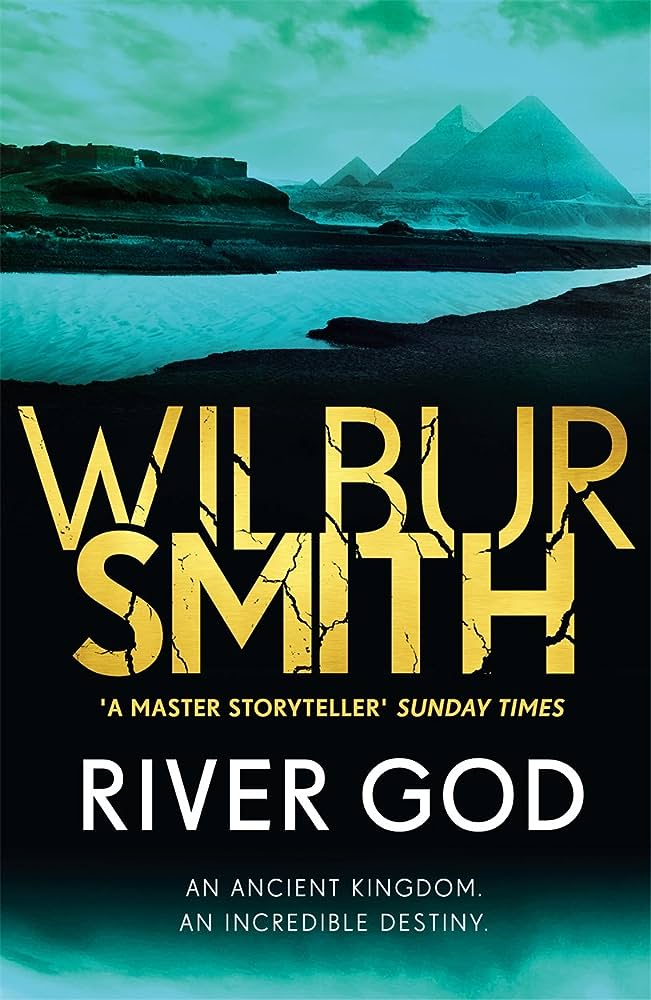
RIVER GOD
Wilbur Smith (wilbursmithbooks.com)
Zaffre (bonnierbooks.co.uk)
£10.99
Buy a copy from your favourite independent bookshop
Taita is a slave to the pharaoh’s grand vizier, Lord Intef, a man whom he fears greatly, and who is responsible for his castration. When Intef manages to manouvre his daughter, Lostris, into the king’s sphere of awareness, and he decides to take her as his newest wife, she asks for Taita as her wedding present from her father. Lostris is in love with Tanus, the commander of the Blue Crocodile regiment of pharaoh’s army and Taita finds himself acting as go-between between the two lovers as he guides his mistress through her duties as pharaoh’s wife, and as the only one of his wives who will eventually bear him a son and heir. As the three navigate their new circumstances, Egypt finds itself facing a major threat: the Hyksos, who have carved a path of death and destruction across the Middle East, have arrived with their horses and their wheeled war machines, and the great army of Egypt cannot adapt quickly enough to fight them. As Taita, his mistress, her lover and the heir to the Egyptian throne go on the run, the world around them is changing, and Egypt will never again be the same.
It’s 20 years, maybe more, since I first met Taita the slave, as part of a sort of literary swap – I gave Reacher and got a copy of River God in return. Wilbur Smith never quite seemed to be my type of author – epic stories of adventure and romance in the wilds of Africa – so I was dubious as I started to read. Almost immediatelty, I was captivated by Taita’s voice, and by the story he had to tell, the story of two young lovers forging their path through ancient Egypt. There was action, intrigue and thrills galore; a wonderfully-realised vision of a time and place that has appealed, I think, to everyone at some point in their lives. And, while Taita’s vainglorious first-person narrative grated for the first few chapters, I soon grew to look past the boastful rhetoric and see the man within, the man who lived for his mistress and his friends. So, here we are, twenty years later, and I find myself visiting with Taita and company once again, and it feels wonderful to be back.
River God is a sweeping epic that covers thirty-odd years of history, translated, if Smith’s afterword is to be believed, from scrolls found in sealed alabaster vases in the tomb of a previously-unknown Egyptian queen in the late 1980s. It begins in reasonably innocent times with Taita not quite thirty and his mistress still little more than a girl at fourteen. Taita, we quickly learn, is nursemaid, inventor, architect, playwright, scientist, mathematician, physician and much more, a polymath who can turn his hand to pretty much anything, and who frequently does. During the course of the novel, we discover that he has built most of the west bank of Thebes, as well as invented the toilet, arrow spoons, bleachers, the spoked wheel and much more. Smith needs no deus ex machina, for Taita can play any role and turn his hand to anything. Like I said, his voice and his style of narration take a bit of getting used to, but it doesn’t take long to suck you into the story.
And what a story. Tanus is discredited by Lostris’ father, the evil and cunning Lord Intef, and charged by Pharaoh to rid Egypt of the bandits who are attacking caravans bringing trade in and out of the country. This happens around the same time that the king, Pharaoh Mamose VIII, decides to take Lostris as his latest wife, following a rare miscalculation by Taita that leads him to believe that Lostris will bear him the son and heir he has long dreamed for. As he and his mistress leave Thebes for the court on Elephantine Island, it is the beginning of a journey that will last thirty years and take all three main characters to Ethiopia and back, see Mamose killed and the eventual ascension to the throne of his son Memnon. Hearts will be broken; lives will be lost; an entire country will come under seige. And through it all Taita will guide us, often pulling the strings, but sometimes as surprised as everyone else by the turn of events.
River God opens with the central trio on a hippopotamus hunt on the Nile, and doesn’t really stop until the heartbreaking final chapter. One action set-piece follows another, with brief interludes for intrigue and plotting, and for brief moments for the star-crossed lovers to spend together. Throughout the novel, as you might expect from the title, runs the Nile, the heart’s blood of Egypt and the focal point of Taita’s story. It is the Nile that allows them to survive in this otherwise harsh landscape, that saves them from complete annihilation when the Hyksos turns up, and which guides them to safety when it becomes clear that they must escape the Hyksos, regroup and plan to retake their country. It’s a constant presence that helps to give the book a wonderful sense of place, and allows Smith to show how the mighty river never changes, even though the cities and the people that rely on it are in a constant state of flux.
River God feels like a complete novel, covering the 30-year period that it does, but it’s merely an introduction to the Ancient Egypt series which now runs to nine books (the most recent three written by Mark Chadbourn). It’s a wonderfully-written novel, and Smith works hard to ensure Taita’s voice remains true throughout which, given its size, is quite a feat in itself. At its heart, it’s a love story, a story about the forbidden love between two young people but also about the love between Taita – a eunuch who still remembers what it was to be with a woman – and his mistress, and the more fatherly love of Taita for the godlike Tanus. But if, like the kid in the The Princess Bride, you’re worried that this is a “kissing book”, then relax: River God is high adventure of the purest sort and many of the chapters will leave the reader breathless and perched on the edge of their seat. Expect plenty of tears, too. Your own, as much of those of the characters; Smith’s narrative draws us in and sets us amongst the protagonists, so when disaster strikes – as it inevitably will, given the duration of the story – it affects us readers in much the same way that it affects the characters with whom we are living.
In short, River God is a book that is well worth your time and effort. The rewards far outweigh the amount of time you’ll spend reading this hefty tome. There’s a little bit of something here for everyone, resulting in a book that should appeal to anyone. Next up, The Seventh Scroll, which takes us to a much more recent time period, and the discovery of Pharaoh Mamose’s long-hidden tomb.

 Reader Dad - Book Reviews