
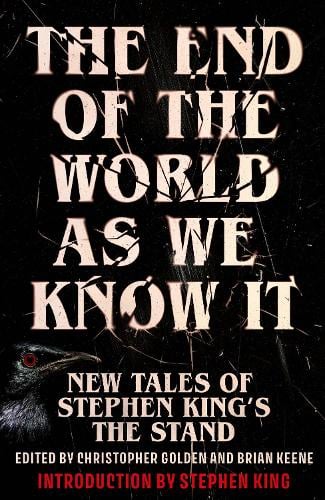
THE END OF THE WORLD AS WE KNOW IT
New Tales of Stephen King’s The Stand
Edited by
Christopher Golden (christophergolden.com)
Brian Keene (briankeene.com)
With an Introduction by
Stephen King (stephenking.com)
Hodder & Stoughton (hodder.co.uk)
£25
Buy a copy from your favourite independent bookshop
Almost 50 years after its first publication (and 35 since its re-release in a much more complete form), Stephen King’s epic novel The Stand remains one of the finest examples of post-apocalyptic fiction that literature has to offer. Often emulated, but never bettered, it tells the story of an America in the aftermath of a super-flu (nicknamed Captain Trips) that wipes out the vast majority of the population, leaving little more than a handful of survivors who split down the lines of good and evil, following centenarian Mother Abigail to Boulder, Colorado, or Randall Flagg – the Dark Man; the Walkin’ Dude – to his base in Las Vegas, Nevada. The Stand has spawned two television miniseries (to varying degrees of success) and a comic-book adaptation that, while excellent, misses a lot of the detail that makes King’s novel so special. To celebrate this epic novel horror giants Christopher Golden and Brian Keene have joined forces and compiled an anthology of stories that take place in the world of The Stand, by some of the biggest authors working today, and a veritable Who’s Who of modern horror.
The book is split into four sections, with titles coming from across the breadth of King’s works (“The Long Walk”, or “Other Worlds Than These”), splitting the stories into a rough timeline within King’s universe: during the outbreak – around the time when King’s characters would have been losing their loved ones and coming to terms with the new world; after the outbreak – which happens while King’s characters are making the long trek across America to Boulder or Las Vegas; after the “event” in Vegas – sometime after the end of The Stand. The final section contains two stories which defy easy categorisation. Topped and tailed by a foreword and afterword by Golden and Keene, the book is given the official stamp of approval in the form of an introduction by Stephen King himself.
The End of the World As We Know It is a very strong anthology, and each author places his or her story somewhere on the timeline of the novel. Some (such as Chizmar’s story) interact directly with the events of The Stand, while others show what was going on off-stage, as it were. The majority of the stories are set in America, which is understandable, given the authors involved, but we also catch glimpses of England and Pakistan, amongst others, and one memorable entry that takes place on a space shuttle. There are a few notable names missing from the content list for whatever reason (Golden and Keene are called out specifically by King in his introduction, which feels like a massive missed opportunity, while it might have been nice to have King revisit the universe after almost fifty years), but overall there’s a lot to love about The End of the World As We Know It, and very little to be disappointed about (besides the fact that it had to end!). As I read, I found myself wondering how different this book might have been in a world where COVID-19 never existed. Much of what we see – especially in the earlier stories while people are still trying to work out how to fight the outbreak – talk about things like lockdowns and toilet roll shortages, stories that come from our experience of having lived through what we all thought at the time might just be The Stand, and so there’s a sense of reality here because these authors are talking about shared experiences, something that their readers have lived through. King didn’t have that “luxury” back in the late seventies, and so we accept much of his theories because they seem reasonable. There’s a part of me that wants to see how The End of the World As We Know It might have turned out in a world without COVID…or, for that matter, how different The Stand might have been if it was written today.
It might have been nice to see a bit more of the world as we journey through the timeline – less focus on America which, let’s face it, King pretty much covers in the source material. There’s a bevy of international horror authors who could have brought that “outside” view, but maybe that’s just the Irishman in me! There are a good number of the stories that feature children or teens in a central role, which is less of a criticism and more of an observation – it’s interesting to see how many authors used these characters as a way into this post-apocalyptic world, and how it contrasts with King’s approach, which takes a much more adult-centric view of the world. But these are minor niggles in the grand scheme of things.
Brian Keene talks in his afterword about re-reading The Stand on an annual basis. For me, it’s not quite as often, but it is a book I return to on a regular basis. And it’s clear that many King fans are similarly disposed. The End of the World As We Know It is likely to become a companion piece for that regular re-read, and the stories told within its pages will become as familiar to Constant Reader as the stories of Frannie and Stu, Larry and Nick and all of the other beloved characters (and, let’s be honest here, all of the hated characters too!) from King’s novel (many might even say “masterpiece”). If you’re a fan of The Stand and you’re waiting for confirmation that this is worth the read, I’m here to tell you that you should stop what you’re doing, and get reading as soon as you can. Not every story will be for every reader – with such a wide variety of authors, even some from without the horror genre – but there’s more than enough variety here to capture the imagination of every reader, and remind us of why we find ourselves returning to The Stand again and again. The rest of this review takes a quick (spoiler-free!) run through the thirty-four stories contained within, but if you take one thing away from reading this piece, it should be this: read The End of the World As We Know It! You won’t regret it, and you’ll find gems scattered throughout that will bring this universe back to life in ways you could never imagine.
Caroline Kepnes, best known for her novel You and its successful Netflix adaptation, opens the anthology by sticking very close to her comfort zone. In “Room 24”, a policeman is called to a domestic disturbance to find a wife making excuses for her abusive husband. He becomes obsessed with her, and when Captain Trips hits, finds himself in the perfect position to rescue her from her situation. But this is a story as old as time, the type of story that Jim Thompson might have written in his heyday, and there is no happily ever after. Wrath James White introduces us to 10-year-old Talik in his story, “The Tripps”, set in the Philadelphia ghetto. It’s a look at good versus evil in microcosm: Talik has the same dreams as King’s characters, and so we find a young boy who needs to be with Mother Abigail, while Flagg uses his family members as puppets to try and kill him and prevent him from becoming part of the Boulder Free Zone, knowing that the more people who join Abigail Freemantle’s ragtag group, the harder it will be to complete his own mission. White also shows us the dark side of humanity, as Talik thinks
The whole world is dying, and niggas is still tryin’ to kill each other.
A flight attendant is the unlikely heroine of the next story as thriller writer Meg Gardiner takes us to Las Vegas several weeks before it becomes Flagg’s stronghold. In “Bright Light City”, taken from the lyrics of Elvis Presley’s Viva Las Vegas, Dani Cooper’s flight is forced off the runway at Vegas airport as it attempts to leave the city during the outbreak’s apex. Grabbing unaccompanied minor, Mollie, Dani flees the airport into the city where she goes into hiding. But Vegas is already changed from its pre-Captain Trips guise, and is now run by the sadistic Amber and her gang. Amber seems to have a direct link to Flagg, and is the main obstacle that stands between Dani and freedom.
“Every Dog Has Its Day” by Bryan Smith introduces us to 17-year-old Corey Adams. Corey lives in Nashville and finds himself alone: his parents have both succumbed to Captain Trips, while his sister has left without him and his dog has disappeared. Out for a walk Corey goes to investigate a barking dog in the distance and ends up having a close encounter with someone you’d rather not meet in a dark alley:
This is what he was thinking when he heard the sound that finally roused him from the worst depths of misery and self-pity. Not the resumption of barking he might have hoped for, but another sound, one that stirred instant unease and prickled the hairs at the back of his neck. Boot heels clocking on asphalt. Not too close yet, but not far away, either. And there was another sound, that of someone – a man – humming a vaguely recognizable tune, a pop song that had been popular in recent weeks, prior to the onset of the plague.
And so, we encounter our first reference to another mainstay of King’s universe that will crop up in story after story: Larry Underwood’s hit record, Baby, Can You Dig Your Man? Walking King encyclopaedia, Bev Vincent is up next with his story “Lockdown”. Set on Seacliff Island, Maine, the 13 residents decide to isolate themselves from the rest of the world. They will stay on the island, and prevent anyone from outside getting too close. The problem is the 2 honeymooners who are trapped on the island with them. There is no surprise that Bev’s tale, despite its isolation, contains the most King detail, and feels like an aside to The Stand.
Horror legend Joe R. Lansdale gives us a gory redneck tale about Ricky from Mud Creek, East Texas in “In A Pig’s Eye“. Ricky flees into the woods when Captain Trips hits, and rescues a girl who is on the run from Gene West, one-time bully and now the town’s chief of police. Gene wants to rape and then eat the girl, and Ricky is standing in his way. Add in a wild boar, and you have the ingredients for a gory but very fun story. Jonathan Janz’s tale, “Lenora”, also involves an animal. 66-year-old Baker Ludlow lives alone having lost his wife and daughters to a house-fire many years before the plague. When a dying pastor delivers him a baby dik-dik from a nearby farm, Baker is dubious – he can’t care for this poor animal. Unfortunately for them both, one of the only other survivors from the local town is psychopath “Dead Ed” Dedaker, who is working his way through the rest of the survivors in the area, and who will force the pair to bond when he attacks Baker’s house.
“The Hope Boat” by Gabino Iglesias takes us to Puerto Rico, where we find Sandra and her neighbour Mercedes. When Mercedes succumbs to the flu she sends Sandra on a mission to find a boat that, she claims, is taking people to a refuge full of survivors. It’s a 10- or 12-mile hike, and it’s the hope of what waits at the end of it that keeps Sandra going. Iglesias’ story takes place in a reality where Stephen King exists as an author, as Sandra packs his novel The Dark Half into her backpack to read on the journey. It also brings news from afar, in a throwaway line:
She said whole families survived in the Dominican Republic.
Next up is C. Robert Cargill’s “Wrong Fucking Place, Wrong Fucking Time”, which takes us back to Texas and introduces us to Derek and Alan, a pair of ranch hands who spend their days tending to the rest of the town’s inhabitants, burying them when they die. They meet Bill, a quiet sort who is the only other survivor in town. Derek and Alan invite him to join them at their bunkhouse where they drink and watch horror double bills every night. As Bill settles into the routine, the three become friends. When they disturb a group of people who have broken into the town’s food mart, Derek and Alan discover that Bill can’t quite distinguish between movies and real life. Hailey Piper’s “Prey Instinct” takes us on the run with Silvia, who is avoiding “the captain”, and anyone who could be carrying it. Silvia is gay in a time when the AIDS pandemic is ravaging that community, and she finds herself comparing it to this new disease as she loses those closest to her. As it turns out, Captain Trips will be the least of her worries.
Tim Lebbon takes us into space in “Grace”. During one of my many re-reads of The Stand, or perhaps during one of my many visits to one post-apocalyptic world or another, I found myself wondering what might happen to the people on the International Space Station as the world ends. Lebbon’s story sort of answers that, as we find ourselves on the Space Shuttle Discovery. The shuttle is carrying nuclear weapons to the SDI platform, Reagan’s so-called Star Wars program. As we join the crew, the pilot Frank is dead, having killed himself and taken Hans as collateral damage. Gemma, Matt and Lizzie, the remaining crew, are trying to work out how to crash the shuttle in a way that ends it quickly and doesn’t cause a nuclear explosion on an already-ravaged planet. But one of them is under the influence of Flagg. Lebbon’s story stands out because it’s so different to any of the other stories, which all follow familiar patterns. It’s one of the hidden gems in a strong anthology and is likely to be one of the stories that sticks in the readers mind.
Fifteen-year-old Tommy Harper lives in Bennington, Vermont. Richard Chizmar’s “Moving Day” follows Tommy as he spends his days on top of the town’s water tower, watching as the army arrive and then die off. Watching, too, as a motorcycle arrives on the evening of July 3rd carrying a man and an older woman. They pitch a tent and spend the night. When Tommy awakes on the morning of Independence Day he watches as the naked man leaves the tent, empties his bladder and sings the National Anthem as loud as he can, before leaving, distraught, the woman still in the tent, obviously having died during the night. With the exception, perhaps, of Nat Cassidy’s off-the-wall entry towards the end of the collection, “Moving Day” is the closest we come to actually intersecting with the events of The Stand, and we’re in safe hands with regular King collaborator Chizmar. Alex Segura’s “La Mala Hora” gives us Desi Calderon who is on the run with her son, Danny. They have been on the run since before the outbreak, when her ex promised he would come to Miami and take the boy from her. They find a small hotel where they can rest for the night, lucky to find a room without any bodies in it. But when Desi wakes in the middle of the night, she discovers they are not alone.
One of my favourite horror authors of recent years is Catriona Ward, whose The Last House on Needless Street is nothing less than a masterpiece, so it’s great to see her included here. Another story that stands out because of its subject matter, “The African Painted Dog” puts us in the head of a juvenile African painted dog that has been raised in a zoo. When Captain Trips hits, the humans slowly stop coming to gawp at them. THE LAST VISITOR comes and shoots all of the animals, dying before he can finish the job, leaving the two juvenile African painted dogs alive. They escape their enclosure during a storm, only to be captured by a group of humans who force them to fight other dogs. The legendary Poppy Z. Brite takes us to Martha’s Vineyard for “Till Human Voices Wake Us, And We Drown”. 19-year-old Seth discovers he is not alone on the island when he bumps into Mole, an old man who sells Jenny Hanivers to tourists, and tells Seth about mermaids. Turns out Mole is an expert, as he’s keeping a mermaid in an aquarium in his old shack, a mermaid who is keeping Captain Trips – as well as who knows how many other ailments – at bay. Like Hailey Piper, Brite compares the super-flu to AIDS (Seth is HIV positive) while presenting a potential cure for both when it is much too late to be of any use to the young man at the centre of the story.
Michael Koryta – using his crime fiction alias, rather than horror alias Scott Carson – introduces us to 27-year homicide detective Eddie Kovach in “Kovach’s Last Case”. Eddie has discovered a serial killer in his hometown of Cleveland. Discovering who it is, he follows her home to discover that she is trying to do some good with the ill-gotten gains of her criminal enterprise. Koryta ties Captain Trips to another King secret military project as Eddie ruminates on the possible existence of a secret military base:
Others put it in Nebraska, or maybe rural Maine, where something called Project Arrowhead was underway, although nobody could agree what Project Arrowhead was.
We head to rural Tennessee for Alma Katsu’s “Make Your Own Way” to close out the first section of the book, where we find Maryellen living in a “hollow” (or is it “holler”?), surviving as those around her die. When Wayne, a college student on his way home stumbles onto her land, he asks if he can stay the night in her barn. One night turns into two, and the pair grow close and fall in love, and it soon becomes evident that Wayne will stop at nothing to make Maryellen up sticks and head west with him. There are shades of Robert C. O’Brien’s classic kids’ novel, Z For Zachariah in this story, so you’ll get no complaints from me! Josh Malerman, best known for his debut novel, Bird Box, introduces us to metalhead Lev Marks in his entry, “I Love the Dead”. When Lev finds a finger, he convinces himself it belongs to the Grateful Dead’s Jerry Garcia, and sets off across the country to deliver it to the legendary rocker. Why he thinks it belongs to Garcia is never really clear, and I’ll leave you to discover for yourself what he finds when he finally arrives at Garcia’s house. This is a fun story that doesn’t necessarily need the super-flu in order to exist, but which fits nicely into the anthology regardless.
Cynthia Pelayo takes us back to Puerto Rico in “Milagros”, where we meet an unnamed young girl who is travelling with her pet chicken, Choco. Girl and chicken are Nebraska-bound – at least in the young girl’s head – but her path is dogged by crows who seem to have other ideas. Next up, another author who is more comfortable in another genre than horror: S.A. Cosby’s “The Legion of Swine” tells the story of Woodrow from rural Virginia, whose family have died and left him alone with a pen full of pigs. When three people turn up on his doorstep looking for food or water, he invites them to dine with him. As they’re leaving, they pull a gun and try to force him to kill one of the pigs for meat. They’re heading for Las Vegas, they tell him, and could do with the sustenance. Let’s just say things don’t work out in their favour, showing that Mr Cosby is as comfortable with horror as he is in his usual genre.
In “Keep the Devil Down” Rio Youers introduces us to Elise and 9-year-old Ruby, who are leaving Arizona, headed for Nebraska. Elise finds herself on a road that was due to be decommissioned before Captain Trips struck – meaning the road doesn’t suffer the same blockages as other roads – and soon discovers that they are being chased by a mysterious car. Youers uses flashbacks to give us glimpses of Elise’s abusive relationship, how she met Ruby, and how she has already been chased by people who want to take Ruby back. Elise and Ruby have an appointment in their near future with a mysterious train that continues to run despite the rest of the world shutting down, but before they get there, we’ll discover that Elise is acquainted with one Hector Drogan, and that, in this brave new world, some items are more difficult to obtain than others:
They checked every aisle and display, but came up empty. Elise sighed, thinking that civilisation’s collapse could be epitomised by the fact that toilet paper was now a luxury item.
As the title suggests, V. Castro’s “Across the Pond” takes us to England, where we find Elizabeth, who has explicit dreams about Randall Flagg on a nightly basis. When she meets Joseph, who also dreams about the Dark Man, she brings him back to the hotel that she calls home and rapes him, taking his knowledge of Flagg as a sign. It’s clear there’s no happy ending in sight for this pair, especially when Joseph is convinced by the Walkin’ Dude that he should drive to America. Husband and wife writing team Tananarive Due and Steven Barnes give us Marie La Guerre in Key West, Florida in their story, “The Boat Man”. Marie has befriended Edmund, a boy about her own age who lives on a boat. Determined to reach Mother Abigail, Marie convinces Edmund to sail his boat up the Mississippi in search of the old woman and attempts to get help from another local survivor, who both know only as “the boat man”.
Paul Tremblay is up next, and takes the interesting approach of populating his story, “The Story I Tell is the Story of Some of Us”, with characters we’ve met before. Told in the first person by Mercy Brown, one of the central characters from his novel, The Pallbearer’s Club, Tremblay lets us listen in on Mercy’s side of a conversation as she meets someone at a campfire on the road west. She begins to tell a story about her friend, Art Barbara (from the same novel), and how he seems to have been identified as the fulcrum in a coming war by followers of both Flagg and Mother Abigail. While we never find out how true Mercy’s story is – and why she is really now alone – she comes across as decidedly unhinged, despite the fact that the only voice we hear for the duration of the story is hers. Usman T. Malik takes us on a journey to Pakistan in his story “The Mosque at the End of the World”. Nasir and Palwasha arrive in the outskirts of Lahore where they discover a blind old imam and the mosque that he refuses to abandon. They decide to stay for awhile, though not in the mosque itself – there is a jinn, the old man tells them, and the young girl would not be safe. Malik’s story mirror’s King’s – and many other post-apocalyptic tales, too – in a much smaller setting, showing that the battle between good and evil is not confined to the shores of America. A community grows up around the mosque, until one day a group of armed men calling themselves the New Pakistan Army turn up, demanding tribute. Luckily for the mosque, and many of the people who now call it home, there is a jinn…
“Abigail’s Gethsemane” by Wayne Brady and Maurice Broaddus is one of the few stories that expands on the story of one of The Stand’s central characters. Focusing on the time she spends in the wilderness, having fled from Boulder, the story examines Mother Abigail’s motives and history, flashing back to when she was a much younger girl and encountered an evil man she knew at the time as the Moon Shadow Man. The authors treat Abigail – and her backstory – with reverence, and it’s wonderful to get this insight into the old woman that was the force for such good in King’s novel. Rising star Ronald Malfi kicks off the penultimate section of the book with “He’s a Righteous Man”, taking us to the community of Calvary on the East Coast. Zarah is pregnant and is, understandably, worried – none of the babies in Calvary have survived past 2 weeks outside the womb. Jacob Cree was a writer in the before times, and seemingly predicted Captain Trips, the split in the survivors and everything else that the world had gone through at that time. Now, a survivor, he travels from community to community talking about his experience, and about how any one of them could be the next prophet. For the people of Calvary, Jacob Cree is seen as a potential saviour, someone who may be able to save their children. It just may not be exactly how Cree expects.
“Awaiting for Orders in Flaggston” by Somer Canon introduces us to Amy, who lives in the community of Flaggston, populated primarily by people who were drawn to Flagg before fleeing eastwards before Trashcan Man arrived with his precious cargo. When Mal, the community’s leader, discovers that Amy never dreamed of either Flagg or Abigail, he decides she is the chosen one, the one most likely to receive messages from Flagg from beyond the grave. He exiles her from the community, locking her in a small shack at night. Her only friend is Zeke, who releases her every morning, and locks her back in her jail every night. And so it continues until Mal runs out of patience. “Grand Junction” is the work of yet another horror legend, Chuck Wendig. Set in the eponymous town thirty years after the nuclear explosion that wiped Las Vegas off the map, it centres on teenager Leaf, a crack shot who is fingered by the community’s leader, Mother May I, to help take down an evil presence who has recently appeared in the form of a man called John Low. But John Low is not what Leaf expected, and others in the hunting party might have received different orders from Mother May I than Leaf did.
Moving to Canada, Premee Mohamed’s “Hunted to Extinction” changes the hopeful tone at the end of The Stand when we discover that a second super-flu ravaged the planet shortly after the explosion in Las Vegas. This virus killed all of the children born since Captain Trips and sterilised all of the surviving men, effectively finishing the job that Captain Trips started. Val lives in a small lake community near what was one Edmonton, Alberta. When she finds a 7-year-old child in a ravine, it looks set to change the course of history again. In “Come the Last Night of Sadness” Catherynne M. Valente tells the story of Fern Ramsay, aged somewhere between 15 and 20, who roams the country in search of the testimonies of people who have died: letters and diaries and any other writings she can get her hands on. Valente intersperses Fern’s tale with excerpts from the diary of Kimberly Lynn McKiver, giving a potted history of the world since Captain Trips. The sting in this particular tale – and it is a beauty – comes when Valente slowly reveals the identity of Fern’s parents.
Another long-time favourite of this reader is Sarah Langan, whose tale “The Devil’s Children” – the last of the stories on a “normal” timeline – seems to take place in an alternate reality to many of the other stories (let’s face it, King is no stranger to the multiverse) – the children in Langan’s world have survived, and the population is thriving, but there’s a division between them: those who hid away from Captain Trips, who are not immune to the disease, and those who survived due to an immunity, In order to protect the first group from the disease carried by the latter, a treaty is signed that assign the hiders to reservations that gradually shrink as the years pass. The hiders pay tribute to the immune on a monthly basis, leaving offerings on an altar at the reservation’s border. When our unnamed narrator arrives at the altar she is captured by the immune (who have styled themselves The Chosen), who have been experimenting on their less-fortunate counterparts for years. But karma, as any horror fan will tell you, is a bitch.
The final section of the book contains a pair of stories that don’t fit into the neat timeline that directs the rest of the anthology. In Nat Cassidy’s “The Unfortunate Convalescence of the Superlawyer”, an unnamed character awakes in the middle of the road in rural Utah. His last memory is of fleeing Phoenix in an attempt to outrun Captain Trips. He is lying next to his Plymouth (which is a car we don’t yet know that we know), and as he gains consciousness he encounters a number of other characters who are almost, but not quite, people we’ve met elsewhere in the King universe. The explanation, when it comes, is a stroke of genius and Cassidy’s story is the single most inventive and unique story in the whole anthology. The final story comes from David J. Schow. “Walk on Gilded Splinters” is set around 1500 years after the events of The Stand and, in a tale reminiscent of Walter M. Miller, Jr.’s A Canticle for Leibowitz, shows us a world where a religion has formed around the events of the novel, and the central characters. The main character here has a story that will ultimately become “The Book of Trash”, if he can survive long enough to get it on paper.

 Reader Dad - Book Reviews