
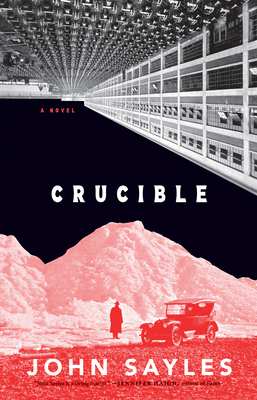
CRUCIBLE
John Sayles (johnsaylesblog.com)
Melville House (mhpbooks.com)
£20
Buy a copy from your favourite independent bookshop
As the Roaring Twenties approach their end, October 1929 brings the Wall Street Crash and the start of what will come to be known as the Great Depression. In Detroit, Michigan, the Ford Motor Company continues to pay its employees generously, hoping that if they ignore it for long enough, it will turn out to be little more than a storm in a teacup. Over the next decade and a half – through to the end of the Second World War – the Company celebrates highs and suffers devastating lows as Henry Ford faces down his worst nightmare: the birth of the unions.
After reading last year’s To Save the Man, I was an immediate convert to the narrative non-fiction of John Sayles. His engaging storytelling style, and obvious deep knowledge of the subject matter at hand combine to produce a book that was as gripping as any thriller, and as entertaining as any work of fiction. So I didn’t hesitate when I was offered a copy of his latest venture, Crucible, which takes us back to Motor City USA as the 1920s became the 1930s and Henry Ford and his Motor Company experienced what is probably the most turbulent period in its existence thus far. The worst economic downturn in living memory led to a period of instability marked by class war, racism and a drive for ever-cheaper production costs, which led to the disastrous purchase of huge swathes of Brazilian land, not to mention the advent of Communism and the labour unions that Ford promised would lead him to give his company away before he would accept unionised workers on his factory floor. What could have been a dry and by-the-numbers history comes to life as Sayles takes us through this period of upheaval through the eyes of a variety of people, from all walks of life, who were affected by the decisions made by the so-called Sage of Dearborn during that fifteen-year period.
Besides Ford and his son, the CEO of the Ford Motor Company at the time, Edsel, Sayles gives us the viewpoints of Harry Bennett, Ford’s enforcer and the head of the storied “Service Department”; Kaz Pilsudski, the Pole who works in a number of different back-breaking roles throughout his tenure with the Company; Zeke Crowder, the Black man who works, like most of the Black men employed by Ford, in the stultifying heat of the foundry; Rosa Schimmel, the young Jewish girl who joins the Communist Party and leads the charge for the formation of the unions, despite never working for the Company herself; Smitty, journalist extraordinaire, who always manages to be in the right place at the right time; and Jim Rogan who, along with his family, is uprooted from his quiet life running a lumber mill in northern Michigan and transplanted to the jungles of Brazil to form Fordlandia, where he will attempt to produce enough rubber to keep up with the demand coming from Ford’s factories. There are plenty of lesser characters who manage to get a word in edgewise, and cameos by more famous names, including boxer Joe Louis, muralist Diego Rivera (and his wife Frida Kahlo) and a blink-and-you’ll-miss-it visit by one Walt Disney.
It’s the spread of sources that makes Sayles’ stories sing. There is no bias in what we’re going to learn here as Sayles ensures that every possible viewpoint is covered, and that every member of the ensemble cast gets their allotted time in the spotlight, to tell their part of the story from their point of view. I knew very little about Ford before embarking on this adventure – I’ve heard of Henry Ford, obviously, and was aware of the Model T Ford, but knew nothing of the Model A, which takes centre stage during the 1930s, or about the advances made by the Company as they went about their business. Sayles takes us to the Willow Run factory and introduces us to the B-24 Liberator, a Second World War bomber produced by Ford, and gives us a glimpse into the spark that led to the game-changing V-8 engine. Don’t get me wrong: technical jargon aside, the car is most definitely not the star here, but little more than a vehicle (pun most definitely intended) to tell the stories of the people – some of them, like the Fords and Harry Bennett, actual individuals, while others are more representative of larger groups of people – who helped to shape the Ford Motor Company, the wider city of Detroit and the history of the automobile industry in America.
The picture Sayles paints is not always a rosy one. As war erupts in Europe it becomes clear that Ford has some sympathies with Hitler and the burgeoning Nazi mindset, while some of the themes that the book explore are as relevant today as they were almost a century ago: the vast divide between the haves and the have nots – the rich sip champagne, or in this case pay famous artists ridiculous amounts of money to paint murals on their factory walls, while the poor starve; and the even-wider chasm between the various ethnic groups – Blacks, Jews, immigrants all treated with varying degrees of disdain and disgust by the people who are supposed to be their neighbours. Even when the American is the immigrant, they still manage to discriminate against and alienate their hosts, as shown by Jim Rogan and his wife’s attempt to separate their daughter and the young Brazilian with whom she has grown up and grown close. It’s a sometimes brutal examination of the darkness that lies in the human heart, at times difficult to stomach, but ultimately rewarding, and a book that, through its examination of one of America’s most famous giants of industry, starts to provide answers to the question of how we ended up where we are today, and the massive imbalances that exist not just in America, but across the globe.
John Sayles continues to impress and Crucible, while seemingly a very niche subject matter, is an excellent look at a specific period of American history, as told through the eyes of people who were involved, in one way or another, with the early days of one of America’s most famous exports. If you’re a fan of Erik Larson’s approach to presenting history, Sayles is definitely someone you need to check out. If you enjoy narrative non-fiction, or are just a fan of great story-telling, he needs to be on your list. I’m intrigued to see where he’ll take us next, and hope it won’t be too long before we find out!

 Reader Dad - Book Reviews