

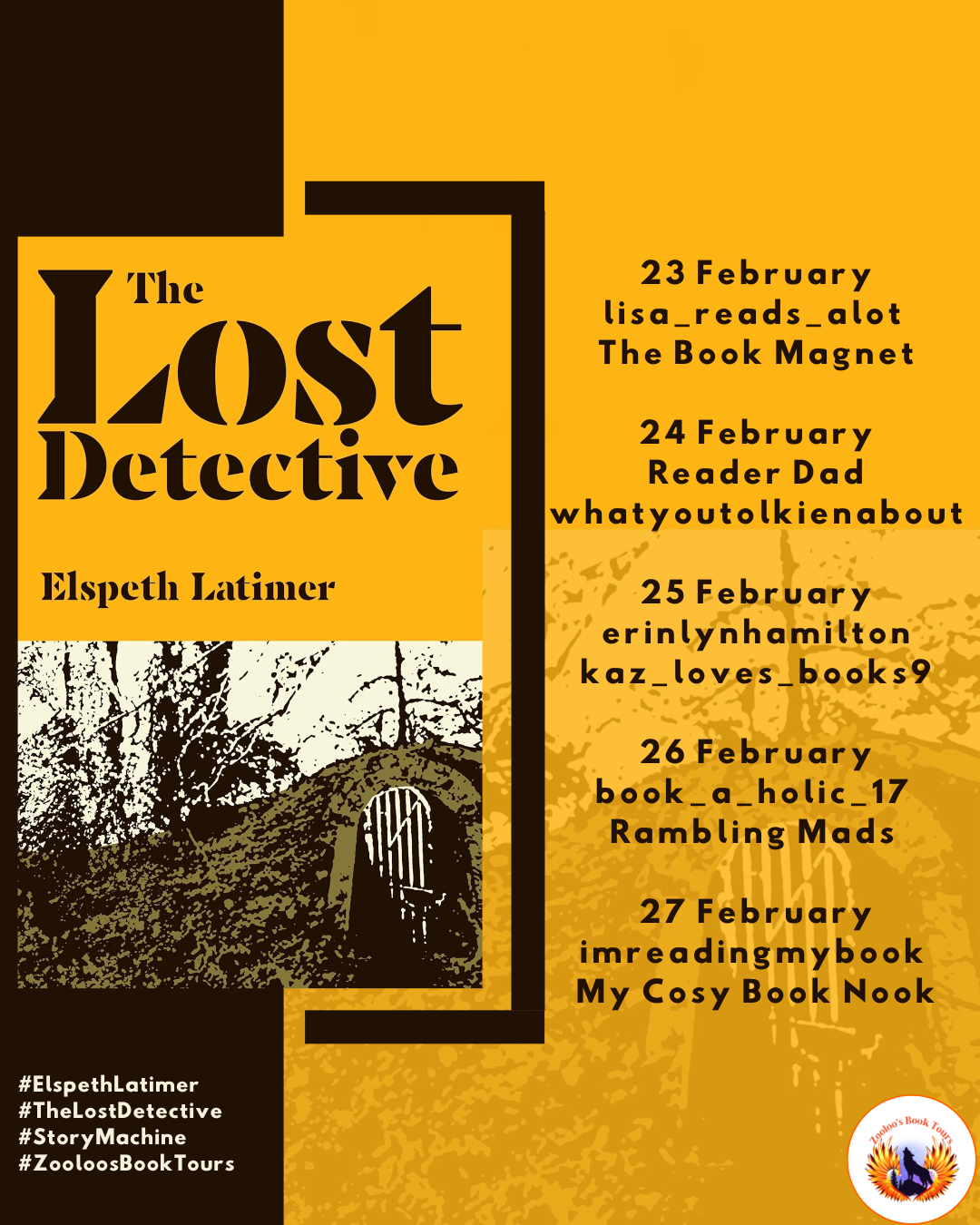
THE LOST DETECTIVE
Elspeth Latimer (Instagram / Facebook)
Story Machine (storymachines.co.uk)
£10.99
Buy a copy from your favourite independent bookshop or through Zoe’s Book Tours
Why do detectives have such a hold on me? I discovered Philip Marlowe in my teens, and VI Warshawski in my twenties, and ever since I’ve been hooked on detective fiction. Whether contemporary or Hardboiled or Golden Age, set in Australia or Denmark or Japan, I want them all. Detectives are my constant companion – I read them, write them, teach them, dream about them, watch them on TV.
And the reason for this obsession? I love how driven they are. Detectives never quit. Once they get involved with a murder, a missing person, an assault, a robbery, they keep going until the bitter end. Detectives are hellbent on exposing what happened and why and who did it. I’m obsessed with the fact that they are obsessed. I love their sheer dedication.
If you find yourself in a dire situation? The detective will never let you down. When you phone them at 3am, they will answer your call, and come running. The detective is your champion, your crusader. The sole person who believes you’re innocent, when you’re surrounded by accusations. They will fight to the death for you. They will break down the locked doors, expose the secrets, unmask the liars, hunt down the killers, grab the world and shake it, until the truth comes tumbling out. And if you’re the corpse? Then be thankful the detective is on your side, grieving your loss and bringing your murderer to justice.
The detective in my own novel, The Lost Detective, is called Dan Hennessy. My first encounter with him, before he even had a name, came as a very clear image that has stayed with me, and which features in the opening chapter. I had a vision of a man in his mid-thirties, sitting on the floor in an empty room, staring at a canister of ashes. Dan used to be a Detective Inspector with Norfolk Constabulary. After a personal tragedy seven months ago, he left his job, blaming the police for what happened. Dan is ‘lost’. Everything that used to anchor him has gone. These days he drives a taxi and stays in a caravan park in rural Norfolk. A life in limbo.
Dan knows what it is like when the worst happens. He is intimately acquainted with loss. Dan is no longer in the police, but being a detective is hard-wired into him. The compulsion is still there. He cannot deny those in need. The mother mourning her baby son. The troubled resident, who vanishes from the caravan park. The dead man found at a nearby solar farm. Dan will answer their call. He will never give up. His friends and former colleagues think he’s mad. But Dan is discovering that not every mystery can be solved by ‘logic’. Some secrets are buried so deep, it takes a lost detective to find them.
I’m a fan of well-plotted crime novels, with lots of interweaving strands and surprise twists. But I also want there to be emotion, for the reader to feel. These two aims were always at the forefront when I was drafting The Lost Detective. Crafting the language is important to me too – making sure there is momentum and pace but also ensuring that the writing is vivid and captivating.
Lee Child read an advance copy of The Lost Detective and wrote me a blurb, describing it as: ‘A superb crime debut – beautifully imagined, beautifully written, stylish, tense and genuinely moving.’ This quote helped persuade me that maybe I’d achieved what I set out to do – write a detective novel that is pacy and gripping but also delivers an emotional hit.
Will I ever be cured of my obsession with detectives? I hope not, as I’m so grateful to have them in my life. Especially Dan Hennessy, my own detective. I have to confess I’m a bit in love with Dan. I hope you fall in love with him too.
Dr Elspeth Latimer has taught on the Creative Writing Crime Fiction MA at the
University of East Anglia. Her debut novel, The Lost Detective, was shortlisted for The Bath Novel Award. She is also author of Writing the Detectives, an academic study of the protagonist in the contemporary crime fiction series, published by Cambridge University Press.

 Reader Dad - Book Reviews